


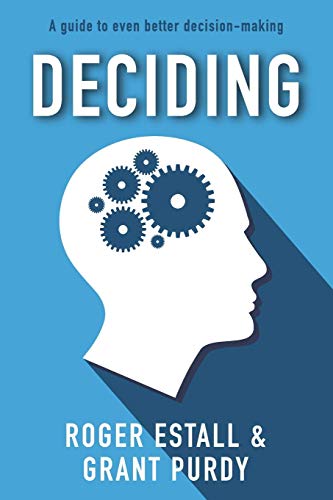

Grant Purdy and Roger Estall have recently published a book on decision-making called Deciding. Written to help decision makers (they call them Deciders) to make ‘even better decisions’ it goes directly to the two big challenges for every Decider – ensuring that each decision will contribute to (rather than detract from) achieving the purpose of their organisation, and being sufficiently certain that the outcomes that result from the decision, are those they intend.
When a decision produces unintended outcomes, it is natural for most Deciders to try to learn from that and improve. Learning from mistakes is one of the ways in which knowledge and humankind have progressed over the ages.
The urge to improve has been particularly strong when the outcomes of decisions adversely affect innocent parties, incur financial loss for one or more parties (such as insurers) or attract public attention and outrage. Enthusiasm for improvement is thus evident in the aftermath of catastrophes such as the explosion of the Challenger space shuttle, the sinking of RMS Titanic, the failure of the Enron corporation, and, in recent years, the revelation of child abuse by religious and other institutions.
It was in pursuit of improvement, particularly in response to spectacular failures, that a variety of (sometimes contradictory) remedial ideas and practices emerged. Some, such as the HAZOP technique, were anticipatory, aimed at improving decisions by consciously considering uncertainty. Other approaches looked back at decisions that had already been implemented, to decide whether subsequent changes should be made in order to make desired outcomes more certain.
Improvement techniques were, however, developed in a random way, with the specific. focus of each, having much to do with the interests, responsibilities and authority of those seeking to bring about change.
Main initiators of change
Initially, those with a vested interest in change fell into one of three broad groups:
- those with a financial interest (such as insurers) or a fiduciary duty (such as the directors of a company);
- those, such as Governments and their regulatory agencies who were (or were perceived to be) accountable on behalf of the public for avoiding further incidents of that type; and
- those with an academic or altruistic interest in improving how organisations are managed. Peter Drucker and Robert Townsend were early examples of the now common ‘management guru’ species.
Each of these three groups of change-drivers had certain ‘levers’ available to them to encourage or enforce adoption of their methods. For example:
- insurance companies had the commercial levers of being able to determine whether to offer insurance and, if so, the price and conditions on which it was offered. In this way, they were able to either require or encourage the adoption of
methods that would result in more certain outcomes (for example, in the early days, requiring jewellers to install high quality safes). - governments and regulators were able to enact and enforce laws to constrain organisations and their Deciders (for example, by establishing safety requirements in construction and minimum liquidity requirements in banking).
- those with an altruistic, academic or ‘common good’
motive to promote better decision-making such as researchers, management experts and those sector peak bodies seeking to improve performance or protect reputation. This group relies on combinations of advocacy, persuasion and training, sometimes labelling their ideas with trendy names and acronyms to give the
appearance of authority (for example ‘Total Quality Management’ or TQM).
Progressively, however, a fourth group of advocates emerged. This comprised those who recognised a commercial opportunity to provide the ‘how to’ services for organisations who were the target of improvement initiatives. In short, external consultants and in-house ‘champions’.
Although the purpose of this latter group was to support organisations seeking to improve decision-making, self-interest seen led many consulting organisations to also become inventors and then advocates for their own methods. As a result, the interests of their clients became merged with or even supplanted by their own interests. As we ¼ill explain, this has contributed to the problems.
Buy on Amazon or read free on Kindle Unlimited
Check out other risk management books
RISK-ACADEMY offers online courses


Informed Risk Taking
Learn 15 practical steps on integrating risk management into decision making, business processes, organizational culture and other activities!

ISO31000 Integrating Risk Management
Alex Sidorenko, known for his risk management blog http://www.riskacademy.blog, has created a 25-step program to integrate risk management into decision making, core business processes and the overall culture of the organization.

Advanced Risk Governance
This course gives guidance, motivation, critical information, and practical case studies to move beyond traditional risk governance, helping ensure risk management is not a stand-alone process but a change driver for business.